Remembering Michael White and a Golden Era of Black Music
By Greg Johnson | Beach City Perspective
Today I went to a memorial service. I left thinking about history.
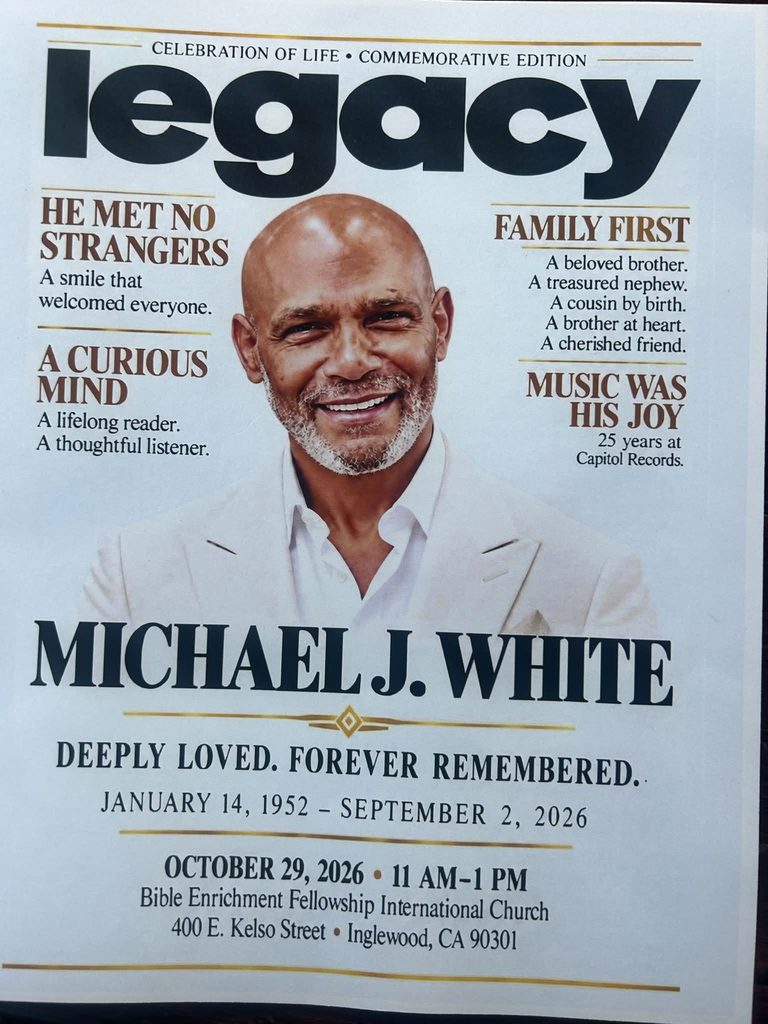
We gathered at Bible Enrichment Fellowship in Inglewood to remember Michael White, a veteran music executive who spent much of his professional career at Capitol Records. Michael’s career intersected with an extraordinary number of artists, records and moments in music. I wouldn’t even attempt to list them all. Michael was the person who invited me to MC Hammer’s debut show at the Palace Theatre (Do y’all remember that??). He was the person who played Kirk Franklin for me when Kirk first emerged. Over the years there were countless records, artists, conversations and moments that Michael shared with me and so many others in the music business. That was our world.But sitting at his memorial today, the records didn’t seem nearly as important as the man.
Michael White was a good man.
Michael had that firm handshake. That good vibe. That smile. He seemed happy with his space in this world. He loved people. And judging from the feeling inside that sanctuary, people loved him back.
We Were Young Once
As the service unfolded, I found myself looking around the room. I saw faces from my past. Some I hadn’t seen in quite some time. Others remain part of my life today. These were people from radio, records and the broader music industry—people who were young when I was young. And suddenly I became conscious of something that perhaps we don’t think about often enough.
We are getting older.
There was a time when we were the young people in the room. We were working. Hustling. Breaking records. Programming radio stations. Promoting concerts. Introducing new artists. Sitting in listening sessions. Going to showcases. Talking about the next record, the next artist, the next opportunity. We were simply doing our jobs. We were the tastemakers, participating in cultural history.
I believe we came through a golden age of the Black music industry. There was an ecosystem surrounding Black music. Record executives, radio programmers and personalities, promotion people, managers, producers, journalists, retailers, club owners, concert promoters and countless others worked inside a professional network that could take music created within Black America and help propel it into the larger culture.
And we made that machinery hum. We didn’t necessarily wake up every morning proclaiming that we were making history. We were working. And history was happening anyway.
A Living Library
That’s what struck me as I looked across the sanctuary. There was a voluminous library of knowledge sitting in that room. Not a library contained on bookshelves. A living library. Inside those people were decades of professional knowledge, intellectual power, creative instinct and culturally historic narratives.
They remember the meetings. They remember the artists before the world knew their names. They remember which records initially struggled and which ones exploded. They remember the radio stations, record companies, clubs, concerts, personalities and relationships that helped shape an era. They remember because they were there.
And increasingly I find myself thinking about the importance of documenting those stories while the people who lived them are still here to tell them. Because history isn’t only what gets written down after everybody is gone. Sometimes history is sitting right next to you.
We Are Still Here
The music industry isn’t what it was in our day. Technology changed it. Consolidation changed it. Economics changed it. The relationship between radio, record companies, artists and audiences changed dramatically. I also have strong feelings about what some of those changes have meant for Black music and Black culture. But that is another column for another day.
I don’t want criticism of the present to diminish appreciation for what existed—or, more importantly, for the people who built it. Because today wasn’t about what we’ve lost. It was about what was in that room. This was the Black music industry. Not the buildings. Not the corporate logos. Not the platinum plaques. The people.
And the underlying vibration in that sanctuary was love. Michael White brought those people together one more time. Perhaps without intending to, his memorial reminded us of what we had built together and what we had meant to one another. I looked around and thought:
We are still here.